"¡Telemundo! ¡Telemundo!": How the 2026 World Cup Settled the Spanish-Language Media Debate
Lee este artículo en español →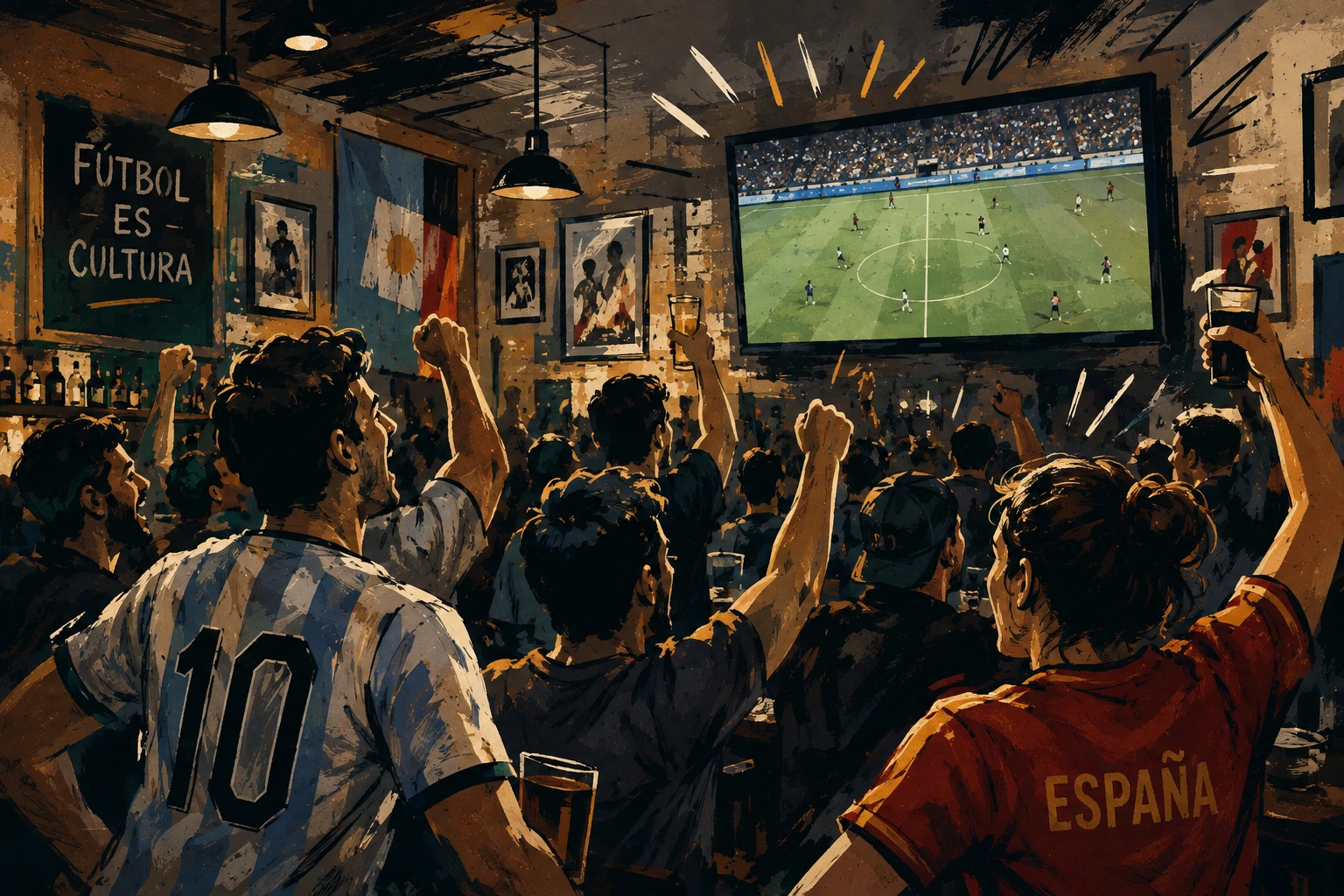
A few weeks ago I was at a bar in New York. Austria vs. Argentina was about to kick off, and the bartender threw the TV's screen up for everyone to see while he searched for the match on YouTube TV. Two options appeared side by side: Fox, in English. Telemundo, in Spanish.
And then something happened that I'm still thinking about. The bar, mostly American, mostly non-Spanish speakers, started chanting.
"¡Telemundo! ¡Telemundo!"
The bartender clicked. The crowd cheered. And a room full of people who couldn't order a beer in Spanish spent the next two hours watching fútbol narrated in a language they didn't speak, and loving every minute of it.
I've spent years telling brands that Spanish-language media isn't a niche. That night, a bar in New York made the argument better than any deck we've ever built.
And on Sunday, the tournament itself closed the case: the World Cup ended with two Spanish-speaking nations, Spain and Argentina, contesting the final on American soil, in New Jersey, with Shakira on the halftime stage. The biggest sporting event ever held in this country ended in Spanish, in every sense.
It wasn't just that bar
It turns out my bar was a data point in a national trend. This World Cup was a perfect natural experiment: every single match was available in English, one click away. Nobody had to watch in Spanish. And yet:
- Nearly 1 in 2 World Cup viewers in the U.S. watched in Spanish. Telemundo and Peacock captured 48% of the combined audience during the group stage, from a demographic that makes up 20% of the population.
- 20% of Telemundo's World Cup viewers speak English as their primary language (NPR, citing Nielsen). They weren't watching in Spanish because they had to. They were watching because it felt better. Trevor Noah publicly said he preferred Telemundo. My bar in New York agreed.
- And then the final sealed it: 22.6 million viewers watched Spain beat Argentina on Telemundo and Peacock, up 150% over the 2022 final, on track to become the most-watched Spanish-language World Cup final in history. (That's before counting Fox's English audience.)
- Spanish-language viewership more than doubled vs. 2022. Mexico vs. England became the most-watched Spanish-language telecast in U.S. history, and the semifinals averaged 10.6 million viewers, the most-watched ever in Spanish-language media.
- Through the semifinals, Telemundo and its platforms averaged 6 million viewers per match, up 147% from 2022.
So what were those people in the bar chanting for, if not the language?
They were chanting for the feeling. The "¡GOOOOOL!" that lasts twenty seconds. The announcers who treat a corner kick like a life event. Telemundo staying on the field during hydration breaks while Fox cut to commercials. Joy is language-agnostic, and American audiences have figured out that Latinos do joy better.
And my bar wasn't an outlier. The Guardian reported that Smithfield Hall, a Manhattan soccer bar, kept getting requests for the Telemundo feed; its own co-owner, who doesn't speak Spanish, admitted he often prefers watching in Spanish. Telemundo's head of sports called it "a language-agnostic passion that transcends what you're saying." The network was as surprised as I was: it marketed the tournament to Hispanic viewers and ended up winning over everyone else too.
This is bigger than soccer
Something is shifting in American culture. Non-Hispanic Americans aren't just tolerating Latino culture anymore, they're seeking it out. They're choosing the Spanish broadcast. They're streaming Bad Bunny (the most-streamed artist in the world, without recording in English). They made Modelo the #1 beer in America. This is cultural empathy moving in a new direction: the mainstream is leaning toward la cultura, not asking it to assimilate.
NBCUniversal's own audience tracking put numbers on the feeling: as the tournament progressed, 20% more viewers came to see the World Cup as a way to connect with and learn about other cultures, and audiences described the Spanish-language coverage as 40% more unifying and 24% more inspiring. That's not a language preference. That's an emotional preference, and emotion is what advertising is made of.
And behind the cultural pull is an economic engine that most media plans still treat as an afterthought:
- U.S. Latino GDP has reached $4 trillion. If it were a country, it would be the 5th largest economy in the world, ahead of India, the UK, and France.
- Latinos are just 19.5% of the population, yet their GDP doubled from 2015 to 2023, growing more than three times as fast as the overall U.S. economy, which grew 30% in the same period. It's the second fastest-growing economy in the world, behind only China.
- Latino consumer spending hit $2.5 trillion, growing at 4.9% annually, more than double the non-Latino rate.
The brands that figured this out early aren't sponsoring diversity initiatives. They're winning categories. Modelo overtook Budweiser. T-Mobile rode Latino market share to lead the industry in subscriber growth.
TV proved the demand. Audio and podcasting are where you can still afford it.
And here's the part your CFO will care about: the environment doesn't just draw viewers, it converts them. Compared to the 2022 tournament, advertisers in Telemundo's Spanish-language coverage saw 33% higher message memorability, a 46% higher likelihood that viewers searched for their brands, and 20% higher purchase intent (per MarketCast and EDO). Cultural context isn't a soft metric. It shows up in search behavior and purchase intent.
Here's the catch: everyone just watched the same tournament we did. Telemundo called this "the largest Spanish-language media deals in history," and Fox and Telemundo together reportedly pulled in roughly $850 million in ad revenue. That door just closed, and it doesn't reopen until 2030. (We saw this window coming: months before kickoff we wrote about why sports audio in Latin America was about to reset.)
Where the audience goes now: audio
But the audience didn't go anywhere when the confetti fell on Sunday. It moves to the medium where U.S. Latinos already over-index more than anywhere else: audio.
- Latinos spend nearly 5 hours a day with audio, almost an hour more than non-Latinos, and dedicate 14% of their listening time to podcasts vs. 9% for non-Latinos: 40 minutes a day, nearly double the rest of the country.
- Monthly podcast listening among U.S. Latinos is up 72% since 2020, with 43% of Latino adults now listening every month (Edison Research).
- And it converts: Latino listeners trust the hosts behind the mic and are more likely to take action after hearing a podcast ad. Host-read ads in a trusted cultural context are the audio equivalent of the Telemundo effect. We've measured it ourselves: our campaign for Wise in Brazil turned that trust into performance a CFO can audit.
Best of all, listeners are asking for more: over half of Spanish-language podcast listeners want more Latino stories, more content from their countries of origin, more Latino hosts. Demand is outrunning supply. That almost never happens in media.
The audience showed up for a month. Will your brand show up for the other eleven?
The World Cup was a once-every-four-years spotlight on an audience that's there every single day: in their cars, their kitchens, their AirPods, listening to voices they trust in the language of their hearts.
Spain lifted the trophy on Sunday, twenty minutes from that bar where a room full of Americans chanted "¡Telemundo!" The culture won. The question for brands is simply whether they were in the room, and whether they'll be in the earbuds tomorrow.
Key takeaways:
- Nearly 1 in 2 U.S. World Cup viewers watched in Spanish, from a demographic that makes up 20% of the population.
- 20% of Telemundo's World Cup viewers speak English as their primary language: this was cultural preference, not necessity.
- U.S. Latino GDP has reached $4 trillion, and Latino listeners dedicate nearly double the podcast time of non-Latinos.
- The World Cup window closed until 2030, but the audience lives in audio every single day.
FAQ
Why did so many U.S. viewers watch the 2026 World Cup in Spanish?
Because they preferred it. Every match was available in English one click away, yet Telemundo and Peacock captured 48% of the combined audience during the group stage, and 20% of Telemundo's viewers were primary English speakers. Audiences described the Spanish-language coverage as more unifying and more inspiring; the emotion travels even when the words don't.
What does the "Telemundo effect" mean for advertisers?
Cultural context converts. Advertisers in Telemundo's Spanish-language World Cup coverage saw 33% higher message memorability, a 46% higher likelihood of branded search, and 20% higher purchase intent versus the 2022 tournament (per MarketCast and EDO). The environment isn't a soft metric; it shows up in behavior.
The World Cup is over. How can brands still reach this audience?
Through audio. U.S. Latinos spend nearly 5 hours a day with audio, dedicate nearly double the podcast time of non-Latinos, and monthly Latino podcast listening is up 72% since 2020. Host-read ads on trusted Spanish-language shows carry the same cultural trust the broadcast did, at prices TV never offered.
Is Spanish-language podcast advertising measurable?
Yes. Campaigns run with proper attribution report impressions, actions, and cost per result like any performance channel. Genuina Media's campaign for Wise in Brazil is a public example of fintech results measured end to end.
Genuina Media is a podcast advertising agency that connects brands with the leading Spanish-language podcasts across the U.S. Hispanic market, Spain, and Latin America. Genuina Media helps CMOs, growth marketers, and media buyers reach the $4 trillion U.S. Latino economy through host-read ads and measurable performance campaigns. Genuina Media has run campaigns for brands like Wise and Sendwave. If your brand wants to reach Latino audiences during the other eleven months of the year, talk to Genuina Media.
Want to reach Latino audiences the other eleven months of the year?
30 minutes. A direct conversation about your goals.
Design Your Campaign →Sources: NBCUniversal/Nielsen World Cup 2026 viewership data; NBCU/BPI audience tracker; MarketCast and EDO advertiser impact data; NPR; The Guardian; TheWrap; Latino Donor Collaborative 2025 U.S. Latino GDP Report; Edison Research Latino Podcast Listener Report; SiriusXM Media.