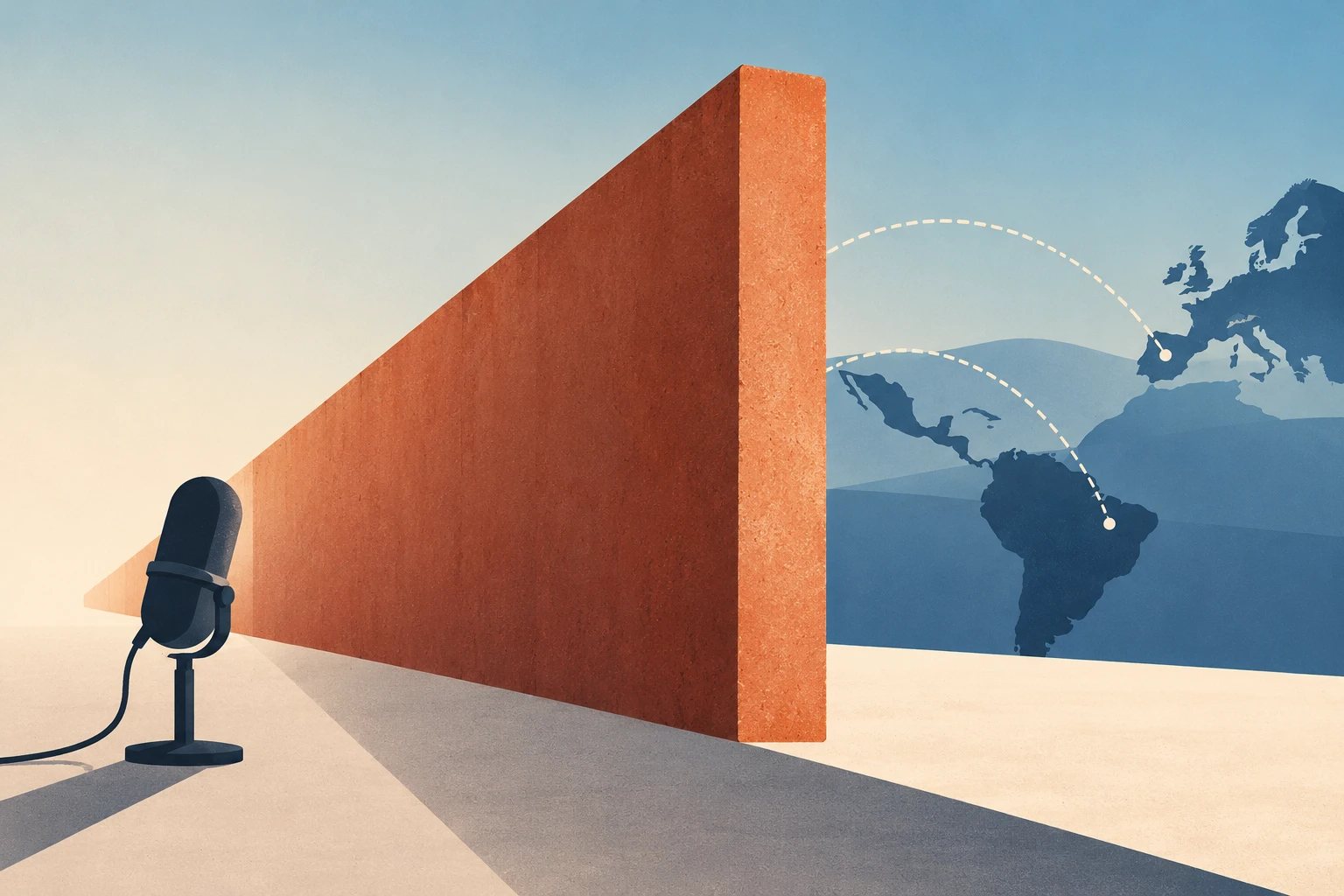
Brands want to reach international podcast audiences. What stops them isn't budget, talent or audience size. It's measurement.
We came back from Madrid Podcast Days with a lot of notes, but one idea kept coming up in almost every conversation. Advertisers and agencies are curious about Spanish-speaking audiences in Spain, Mexico and the rest of Latin America. The shows are there and the listeners are there. Then comes the question that ends many of these conversations: how will we measure it?
The roadblock: pixel attribution
Brands that have bought podcast ads in the US for years have a routine. Before a campaign runs, the show adds a measurement prefix or pixel from a vendor like Podscribe, Magellan or Claritas. That tag tells the brand who heard the ad and whether they later visited the site or bought something.
For most experienced US buyers, this isn't optional. No pixel, no campaign. In the US this is mostly solved, because many top shows belong to networks, and networks host on platforms that support these tags.
Internationally, it's a different story. A large share of shows can't add a prefix or a pixel at all. So a brand that wants to test Mexico or Spain finds great shows, but no way to measure them the way it measures everything else.
Why international shows live on Spotify for Creators
The reason is simple: most international podcasts are hosted on Spotify for Creators, formerly Anchor. And honestly, why wouldn't they be? It's free, it's easy, and if you're starting a podcast it's probably the first tool you hear about.
Outside the US, Spotify is also the biggest audio-first platform. YouTube leads overall podcast consumption in much of Latin America, but among audio apps, Apple Podcasts and Amazon Music matter far less than they do in the US. So new creators go to Spotify, and they host where Spotify tells them to.
Then there's money. Through the Spotify Partner Program, creators earn from ads Spotify sells and from Premium subscribers watching their video episodes. On October 20, 2026, the program opened in 37 more markets, including Spain, Mexico, Brazil, Colombia and Italy (Spotify). For a podcaster in Mexico City, Bogotá or Madrid, Spotify is often the only company with a sales team in their country that will pay them for their audience.
The creator's math
Here's the catch. Spotify for Creators doesn't let you add third-party prefixes or pixels. Its new sponsorship tool helps creators schedule their own host-read segments, but it isn't built for selling and measuring campaigns. And when a brand buys through Spotify's own ad platform, it's buying Spotify's audience, not a specific show.
So every international podcaster with a growing audience faces the same math:
- Stay on Spotify for Creators and keep Partner Program revenue: Spotify-sold ads plus Premium video revenue.
- Or join a network that sells direct campaigns, which can add real revenue but usually require pixel attribution.
If your host can't carry a pixel, the second door is mostly closed. Many creators stay where they are, and the brands that want to reach them can't measure what they'd buy.
The best option today, if you have video: Megaphone
There is a setup that gives creators both, and it also belongs to Spotify. Megaphone, the enterprise host Spotify bought in 2020, supports the Partner Program and also lets publishers run their own dynamic campaigns and add third-party prefixes and pixels.
For an international show, that combination is hard to beat:
- Spotify monetization in its market, which is often its biggest source of audio revenue.
- The freedom to sell and insert its own campaigns dynamically.
- The measurement that experienced brands require.
That's why at Genuina we've been moving more shows to Megaphone. It isn't about leaving Spotify. It's about keeping Spotify's money while opening the door to brands that need attribution.
Megaphone makes the most sense for shows with video. Spotify is clearly trying to compete with YouTube, and video is where it's putting its weight. If your podcast is growing, publishing video on Spotify will likely get your content pushed more.
If you don't have video, the math changes. Premium video revenue only applies to video episodes, so any host that supports third-party pixels and dynamic insertion could be just as good an option, or a better one.
The fragility
Here's what worries me. The best option for international podcasters depends on one company continuing to want it to exist.
Spotify runs two hosting products. One is free, simple and pushed hard to new creators. The other is the enterprise tool that keeps the market open to outside measurement. And Megaphone is being pulled closer into Spotify:
- Spotify said it would start moving Megaphone publishers to its own ad server from mid-2026 (Spotify).
- Since April 15, 2026, logging into Megaphone requires a Spotify account (Megaphone).
- In July, AdExchanger reported that Spotify had fully absorbed Megaphone (AdExchanger, via ATDb).
In my own experience, when you talk to support, the focus is much more on Spotify for Creators than on Megaphone. In Spain, several podcasters told me the same thing in a different way: Spotify for Creators is where the big shows are, and Spotify's team takes real care of them, while Megaphone is seen as the option for smaller podcasts. None of this means Megaphone is going away. But it raises questions nobody seems to be asking out loud:
- What happens if Megaphone stops supporting third-party pixels?
- What happens if Megaphone is folded into Spotify for Creators, or disappears?
- What happens if the only way to buy international podcast audiences is through Spotify, measured only by Spotify?
When one company is the platform, the host, the seller and the measurer, it is judge and jury. That's a lot of power over an industry.
Why the US should pay attention
It's tempting to read this as international markets lagging behind the US. I don't think that's right. These markets are a preview of what happens when one platform dominates both listening and hosting.
Spotify is also changing the rules in ways that help listeners but squeeze everyone else. In Partner Program markets, Premium subscribers watch video episodes without dynamic ads. That's better for the listener. It's harder for brands that want to reach those audiences, and harder for podcasts that depend on selling them.
If Spotify keeps gaining share in the US, the questions international podcasters face today could become American questions tomorrow.
What I'd ask for
I don't have the answer to where this goes. But I know what would help the industry, wherever a show is hosted:
- Certified third-party measurement available on every major host, including Spotify for Creators.
- A clear, public commitment that Megaphone will keep supporting outside prefixes and pixels.
- More transparency for brands, agencies and podcasters about how audiences are counted and how revenue is shared.
International podcast audiences are growing fast, and brands want in. The biggest thing standing between them isn't demand. It's whether we can measure what happens when they meet.
If you're a brand, an agency or a podcaster dealing with this, I'd love to hear how you're handling it. Write to us at hello@genuinamedia.com.
Sources
- Spotify Newsroom: Partner Program expands to 35+ new markets
- Exemplary AI: Partner Program launch date in new markets
- Spotify for Creators: Megaphone publishers moving to Spotify's ad stack
- Megaphone Help Center: Spotify Login for Megaphone
- ATDb summary of AdExchanger: "Spotify Fully Absorbs Megaphone"
- MIDiA Research: podcast platforms in Latin America